Rugby Ball Size Guide: Sizes 3, 4 & 5 Explained
Choosing the right size rugby ball matters more than most players realise. the wrong size slows skill development in kids, makes passing harder than it should be, and gets in the way of proper kicking technique.
this guide covers every rugby ball size in use today - 3, 4, 4.5 and 5 - with official dimensions, the age groups they're built for, and how to pick the right one for your game. we've included the full spec for each size as set by world rugby, so you can buy with confidence.
this guide covers rugby union. we've noted differences with rugby league where they matter.

| Size | Age Group | Length | Girth | End-to-End | Weight |
|---|---|---|---|---|---|
| Size 3 | Ages 6–9 (mini rugby) | 255mm | 540mm | 680mm | 300–340g |
| Size 4 | Ages 10–14 (junior rugby) | 275mm | 555mm | 720mm | 360–390g |
| Size 4.5 | Transition / women's / touch | 280mm | 570mm | 730mm | 380–410g |
| Size 5 | Ages 15+ (senior / pro) | 280–300mm | 580–620mm | 740–770mm | 410–460g |
SIZE 3 RUGBY BALL: MINI RUGBY (AGES 6–9)
size 3 balls are built for young players just learning the game. smaller and lighter than a senior ball, they fit comfortably in small hands and let kids develop clean passing, catching and kicking technique without fighting the ball.
official size 3 dimensions:
length: 255mm
girth: 540mm
end-to-end: 680mm
weight: 300–340g
best for: under-7, under-8 and under-9 rugby. first rugby balls. school PE.
SIZE 4 RUGBY BALL: JUNIOR RUGBY (AGES 10–14)
size 4 is the step up. heavier and longer than a size 3, it prepares players for the weight and flight of a senior ball while still being manageable. most youth tournaments from under-10 through under-14 use size 4.
official size 4 dimensions:
length: 275mm
girth: 555mm
end-to-end: 720mm
weight: 360–390g
best for: under-10 through under-14. youth clubs. school rugby up to year 9.
SIZE 4.5 RUGBY BALL: TRANSITION, WOMEN'S, TOUCH
size 4.5 is a transition ball — sized between a junior and senior. it's used in three main ways:
transition: bridging the gap for players moving from size 4 to size 5, particularly useful for kids with smaller hands
women's rugby: some clubs and programmes use size 4.5 in training, though world rugby match play is size 5
touch rugby: the slightly smaller, lighter ball suits the fast-handling game
size 4.5 is not legal for rugby union match play at any level. use it for training, skill development, touch and tag formats.
SIZE 5 RUGBY BALL: SENIOR AND PROFESSIONAL (AGES 15+)
size 5 is the official match ball from under-15 through elite international rugby — in both the men's and women's game. every ball used in the premiership, six nations, super rugby, world cups and grassroots senior leagues is a size 5.
official size 5 dimensions (world rugby law 2):
length: 280–300mm
girth: 580–620mm
end-to-end circumference: 740–770mm
weight: 410–460g
pressure: 9.5–10 psi (65.7–68.8 kPa)
construction: oval, four panels, leather or approved synthetic
best for: colts, senior club rugby, university, professional and international play.
HOW TO CHOOSE THE RIGHT RUGBY BALL
size is the first question. once that's settled, three more things decide which ball you actually buy.
1. match ball or training ball
match balls are built for performance — superior grip, precise flight, natural rubber outers. they cost more and wear faster. training balls are built to survive — tougher synthetic rubber, better air retention, more durability per session. most clubs run a mix: a few match balls for saturdays, a bigger set of training balls for the rest of the week.
2. grip pattern
the pimples on a rugby ball are its tyres. deeper, more defined pimples grip better in the hand and in wet conditions — ideal for match play. lower-profile pimples last longer but grip less — ideal for training.
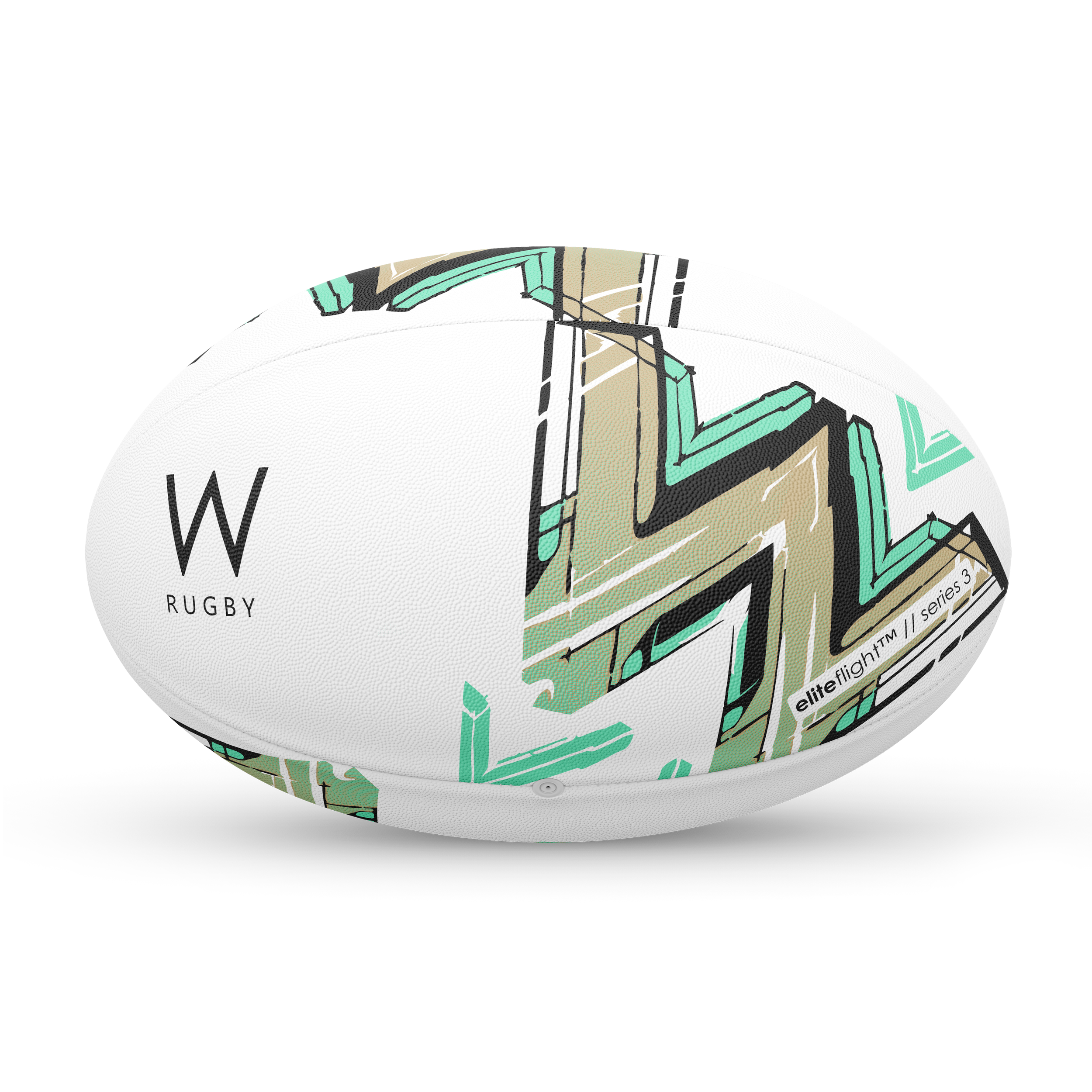
W RUGBY's eliteflight™ series 3 uses a grip pattern engineered for 30% better grip than a standard match ball, tested in wet and dry conditions.
3. surface
artificial turf is brutal on rugby balls. abrasive, unforgiving, and it wears out standard rubber fast. if you train on 3G or 4G pitches regularly, get a ball built for it: reinforced outer, tougher material, deeper grip pattern.
RUGBY BALL WEIGHT, PRESSURE AND BLADDER. WHAT ACTUALLY MATTERS?
the bladder is the most important part of a rugby ball most players never think about. it decides how the ball bounces, how long it holds air, and how it feels in the hand.
natural latex: best feel, best bounce, loses air faster (re-inflate weekly)
butyl: good balance of feel and air retention, common in mid-range balls
synthetic / proprietary: holds air 1–2 months, less feel, used in training balls
every W RUGBY ball uses a natural latex bladder inside a natural rubber outer — the combination behind our precision flight and match-grade grip.
correct inflation pressure is 9.5–10 psi. an under-inflated ball wobbles in flight and loses distance on kicks. over-inflated balls feel hard and reduce grip.
RUGBY UNION VS RUGBY LEAGUE BALLS
rugby union and rugby league use balls of similar size but different shape. league balls are slightly more pointed and narrower, designed for the flatter, faster passing game. union balls are rounder at the ends — better for kicking out of hand and from the tee.
this guide focuses on rugby union. if you're playing league, buy a league-specific ball.
FREQUENTLY ASKED QUESTIONS
What size rugby ball for a 7 year old? A size 3 rugby ball. Size 3 is the official ball for mini rugby from under-7 through under-9.
What size rugby ball for an 11 year old? A size 4. Size 4 is used from under-10 through under-14 in junior rugby.
What size rugby ball is used in professional rugby? Size 5. Every professional match in rugby union — men's and women's — is played with a size 5 ball that meets World Rugby Law 2 dimensions.
Do women play with a smaller rugby ball? No. The international women's game uses a size 5 ball, the same as the men's. Some clubs trial size 4.5 in training, but size 5 is the legal match ball.
What's the difference between a match ball and a training ball? Match balls prioritise grip and flight using natural rubber outers and tighter specs. Training balls prioritise durability using tougher synthetic materials. Both come in every size.
How do I know when to replace a rugby ball? Replace it when the grip has visibly worn smooth, the ball no longer holds air for a full session, or the shape has deformed. A good match ball lasts a season of regular play.
What's the weight of an official rugby ball? A size 5 match ball weighs 410–460g, set by World Rugby. Size 4 is 360–390g and size 3 is 300–340g.
WHY W RUGBY BALLS
every W RUGBY ball is built for grassroots and elite play alike. natural rubber outer for match-grade grip. latex bladder for precision flight. a grip pattern engineered for 30% better grip than a standard match ball.
and every ball sold donates a ball to a grassroots club through Project: Won for Won™ — chosen by you.